Healthy Attachment
Setting and respecting healthy boundaries, being responsive to each other's needs, and building trust over time.
KCRealtime can personalize nearby shelters, family justice centers, legal aid, and counseling resources.
Start with healthy relationship indicators: attachment, trust, respect, support, accountability, fairness, partnership, and communication. Warning signs and safety resources remain available below.
Setting and respecting healthy boundaries, being responsive to each other's needs, and building trust over time.
Respecting each other's feelings, friends, activities, and opinions while listening without judgment.
Supporting one another's goals, education, career, family, friendships, hobbies, and activities.
Accepting responsibility, making amends, and having open, honest, non-violent communication.
Seeking mutually satisfying conflict resolution, accepting change, and being willing to compromise.
Valuing open communication, privacy, equality, shared decisions, and fair distribution of resources.
Pausing before responding and noticing emotions without letting them control the moment.
Protecting time, privacy, values, and emotional space without over-explaining.
Recognizing that a respectful no is healthy, honest, and sometimes necessary.
Not taking responsibility for regulating, fixing, or carrying another person's emotions.
Letting people own their choices, feelings, consequences, and repair work.
Using triggers as information about wounds, needs, boundaries, and healing work.
Making room for comfort, play, validation, safety, grief, and self-compassion.
Learn to recognize triggers, understand reactions, and develop healthier responses before situations escalate.
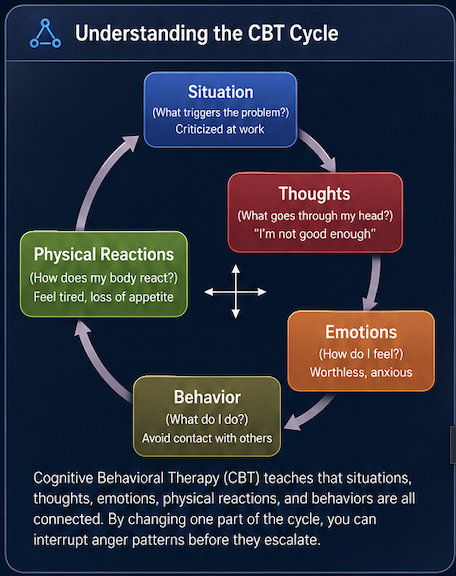
Free, evidence-based workbook using CBT techniques.
CBT has strong evidence supporting:
When you notice anger rising:
Healthy relationships affect nearly every part of life: family, parenting, dating, friendships, work, and community. KCRealtime includes relationship resources because useful local information is not only about traffic, weather, and events. People also need tools that help them communicate better, recognize unhealthy patterns, manage conflict, and make safer decisions.
A healthy relationship usually includes respect, honesty, trust, boundaries, accountability, and the ability to disagree without fear. No relationship is perfect, but people should be able to talk through problems without intimidation, threats, manipulation, or ongoing emotional harm. Learning the difference between normal conflict and unhealthy patterns can help people protect themselves and improve how they treat others.
This page focuses first on healthy relationship skills. That includes recognizing emotional triggers, taking time-outs before arguments escalate, listening without immediately reacting, apologizing clearly, respecting boundaries, and avoiding control-based behavior. Strong relationships are not built only during calm moments; they are also shaped by how people handle stress, disappointment, jealousy, anger, and disagreement.
KCRealtime also includes resources for identifying energy givers and energy takers. Some relationships leave people feeling supported, calmer, and more capable. Others repeatedly create confusion, guilt, fear, exhaustion, or instability. Paying attention to those patterns can help people decide where to set boundaries and where to invest more care.
This page is not therapy, legal advice, or a substitute for professional support. It is a starting point for reflection and learning. People dealing with abuse, threats, stalking, coercive control, or immediate danger should seek help from qualified professionals or emergency services. For everyday growth, this page offers practical guidance for building healthier communication, stronger boundaries, and more stable relationships.